
Recently, two popular games have emerged, one is "Poker Dreams" (a mix of Texas Hold'em and CoinMaster) which features Casino gameplay, and the other is "RACCOIN: Coin Pusher Roguelike" for PC. The former combines Texas Hold'em poker hands with social gambling elements, while the latter transforms the classic arcade coin pusher into a deep Rogue product. The success of both games provides valuable references for traditional gambling game development.
↗️ "Poker Dreams": A strong combination of Texas Hold'em and CoinMaster mechanics
"Poker Dreams" developed by YOOKU GAMES, a company known for its fishing games, was launched on the Google Play platform around December 2025. It deeply integrates Texas Hold'em poker hands with classic CoinMaster-like social gambling gameplay.
The core gameplay involves players rolling dice to move on a board, each square corresponding to a poker card point, accumulating 5 points to form a hand (pairs, straights, flushes, etc.), and earning green cash rewards according to Texas Hold'em rules.
Peripheral gameplay introduces CoinMaster-style Heist robbery, Attack, Defense, and other social interactions, forming an SLG gameplay of resource plundering and village building.
"Poker Dreams" currently has over 10K downloads on Google Play. Although there is no public revenue data yet, similar CoinMaster products have top cases with monthly revenues reaching hundreds of thousands to millions of dollars.
This game, through the combination of card types and social elements, has certain explosive potential in fragmented mobile scenarios, especially suitable for light users. The Casino combined mode has unique advantages in viral spread and long-tail conversion, and is particularly easy to form a community effect.
↗️ "RACCOIN": A phenomenal hit with coin pusher gameplay
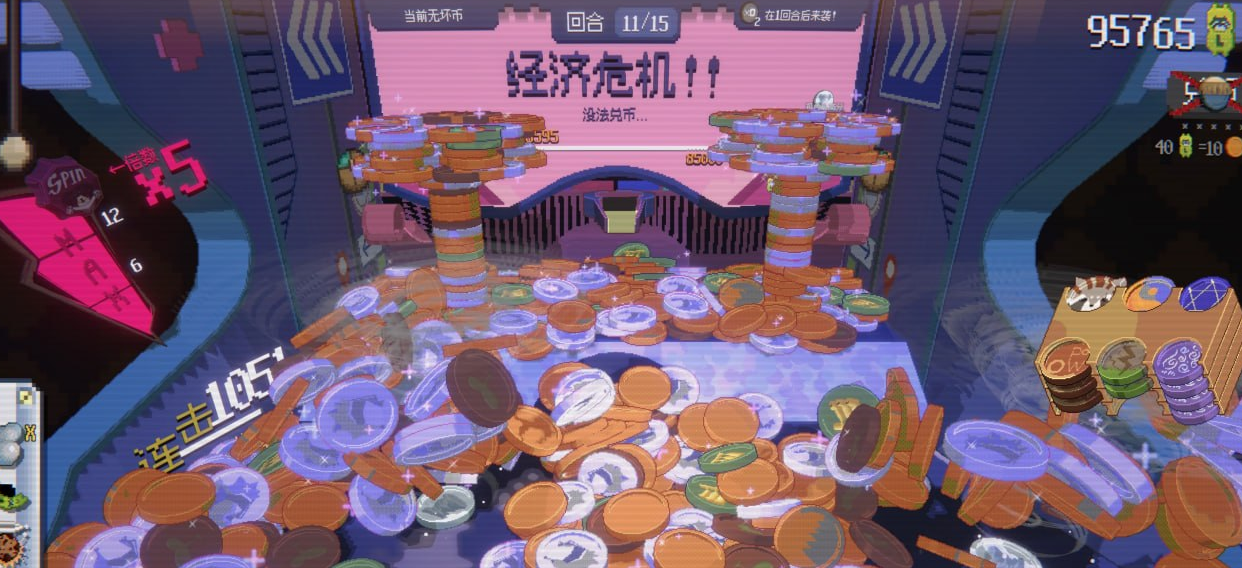
Developed by Doraccoon and published by Playstack (publisher of "Joker Card"), "RACCOIN" was launched on Steam on March 31, 2026. It is the closest digital game to traditional arcade/casino coin pushers.
It retains the physical critical feedback engine of the coin pusher, injecting rich Rogue depth. The game's main gameplay is based on the classic coin pusher board, where players insert special coins with specific functions, including multiplication, explosion, resource cycling, and triggering rewards.
The board physically simulates the real accumulation and collapse process, creating high anticipation for players, similar to arcade coin pushers and Pachinko machines.
The game's first-day sales exceeded 100,000 units, corresponding to nearly 10 million RMB in revenue. The first week's estimated revenue was about 3 million USD (about 20 million RMB), with sales exceeding 400,000 units. Cumulative sales are estimated between 378,000 and 591,000 units, with early Steam revenue starting at about 760,000 USD, and current concurrent online maintaining in the hundreds to nearly a thousand range.
Players have an average playtime of 4.3 hours, with 60% of players playing for more than 2 hours. It surpassed some mainstream products in first-week sales, fully demonstrating the strong explosive power of visualized gambling mechanisms.
🧮 The combination of traditional gambling mechanisms in games
Integrating traditional gambling mechanisms into games, 🔴 also known as gamification of gambling games, can definitely create hit products. These cases show that traditional gambling games, if cleverly gamified, can not only retain the core addictive feeling but also significantly expand the user base and lifecycle through system depth.
➡️ The key lies in combining the randomness of gambling odds with the subjective agency of players, making players always feel they can manipulate or influence the odds. This design is the core of why gamified gambling mechanisms can persist long-term.
Developers can achieve this goal through various proactive gameplay, such as cumulative gameplay: players gradually accumulate resources over multiple games, upgrading or unlocking permanent enhancements, which increase subsequent success probabilities, such as increasing reward drops or boosting chain multipliers.
Design techniques are equally important, such as referencing #Crash type games, which can design timing choices, placement decisions, and other player judgment and operation elements, such as manually adjusting the platform angle or making real-time coin insertion decisions in the coin pusher.
Furthermore, deeper game systems can be built for diversified expansion. Through these methods, traditional gambling games can create more exciting, strategic, and enduringly attractive quality products, providing more innovative directions for the entire industry.
—————
This is the only gambling industry knowledge channel on TG, targeting elite executives in the gambling industry. Produced by "Global iGaming Leader - PASA". Deep content analyzing the past, present, and future of the gambling industry is published daily.
This content is exclusively created byhttps://t.me/gamblingdeep. If you like our content, feel free to share it.
Follow this channel to receive a free copy of "Gambling Abroad Strategy, from Strategy to Practice Guide". After following, send a private message to @Pasarose_bot to claim.
More data reports: @pasa_research
Join the member group: @pasa002_bot
PASA official website: www.pasa.news