
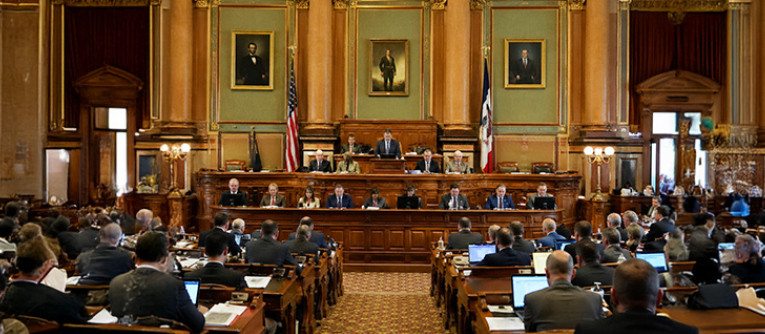
Iowa and Ohio are taking a different regulatory path from federal litigation, opting to directly incorporate prediction markets into their respective gambling regulatory frameworks through legislation. An Iowa House subcommittee has advanced Bill "Senate File 2470," which requires prediction market platforms to obtain state government permission before operating, setting a rather expensive entry threshold—a $20 million initial license fee, a $100,000 annual renewal fee, and levying a 20% tax on adjusted income and a 20% sales tax on each contract within the state. State analysts estimate that this structure could bring about $40 million in revenue to the Iowa General Fund in the fiscal year 2027, although a decline is expected in subsequent years after the initial license payment. The bill previously passed the Senate with an overwhelming majority of 45 votes in favor and 1 against.
In Ohio, Senator Bill Demora's "Senate Bill 430" took another path, directly classifying sports event contract trading in prediction markets as sports betting in legal definitions, requiring platforms offering such contracts to obtain approval from the Ohio Casino Control Commission and to be taxed and regulated in the same manner as licensed sports betting operators. Demora's move was driven by a series of regulatory tug-of-wars with Kalshi—after receiving a cease-and-desist order, the company sued Ohio, but the federal court dismissed its preliminary injunction request, and regulatory authorities have indicated plans to issue a $5 million fine.
Iowa's $20 million license fee and 45:1 Senate overwhelming
Iowa's bill outlines a complete regulatory closed loop. Conceptually, the bill defines prediction markets as platforms that allow users to trade contracts linked to real-world outcomes such as sports events, elections, and global developments; economically, the initial license fee of $20 million and an annual renewal fee of $100,000 directly filter out most small and medium-sized platforms, while the 20% income tax and 20% consumption tax constitute a dual fiscal extraction mechanism; operationally, incorporating prediction markets into the jurisdiction of state gambling regulatory bodies, making them bear compliance obligations equivalent to licensed casinos in terms of anti-money laundering, consumer protection, and responsible gambling. State Senate Majority Leader Mike Klemish was very straightforward in promoting the bill: "This is us trying to do something rather than waiting another year for them to grow their user base." This implies that even without clear federal guidance, state regulatory bodies prefer to take the initiative rather than continue to stand by and watch platforms expand wildly in a regulatory vacuum.
Iowa State Representative Shannon Lundgren spoke frankly, feeling it seemed like gambling, but she admitted she still lacked enough information to make a final determination today, but she would definitely sign the bill and hoped the dialogue would continue. Kalshi's acting attorney, Logan Shane, tried to persuade the legislators to hit the brakes, considering the multiple lawsuits surrounding the issue and that these cases are likely to end up in the Supreme Court, the prudent approach should be to pause and see where the litigation goes. He warned that the revenue expected in the bill is unlikely to truly end up in Iowa's pocket in the short term. However, the subcommittee was not swayed by these warnings.
Ohio classified as sports betting, directly applying the regulatory template
Ohio's approach is simpler than Iowa's. Demora's bill does not attempt to create a new regulatory framework but directly incorporates sports event contract trading into the existing legal system's definition of sports betting, using the most effortless way to drag prediction markets into the mature gambling license, tax, and compliance system. The prerequisite requires formal approval from the Ohio Casino Control Commission. The advantage of this strategy is that it can quickly build a regulatory barrier for prediction markets by leveraging existing law enforcement experience and institutional inertia, without the need to draft a new law from scratch; the disadvantage is that it avoids defining the essential differences between prediction markets and sports betting, leaving room for future judicial challenges.
PASA official website continues to track the latest developments in prediction market legislation and federal-state jurisdictional struggles in the US, noting that Iowa and Ohio have chosen a path completely different from federal litigation—not relying on court decisions to determine the legal attributes of prediction markets, but directly using legislative power to define and incorporate them into the tax system. Iowa, in particular, stands at the forefront of state practices, and whether its legislative process can withstand subsequent judicial challenges will provide the first case coordinate for the feasibility of state legislative paths.
————
This article is from "PASA-Global iGaming Leaders," a gambling industry news channel: https://t.me/pasa_news
Original deep channel for gambling: https://t.me/gamblingdeep
Free data reports: @pasa_research
PASA Matrix: @pasa002_bot
PASA official website: https://www.pasa.news