
The boundaries between sports betting and prediction markets are rapidly blurring. As traditional bookmakers start to treat market making as a new business, an interesting thing happened: the risk management capabilities accumulated by betting companies over decades are exactly the liquidity supply capabilities most scarce in prediction markets. PASA's official website noticed that DraftKings and FanDuel have already taken the lead, and the academic community is also providing theoretical ammunition for this business.
Market making is essentially the new bookmakers DraftKings and FanDuel taking the lead
Traditional sports betting and prediction markets have some loose similarities—such as financial modeling and pricing. But prediction markets are classified as derivatives exchanges, relying on market makers to provide liquidity between buyers and sellers. Early prediction products like the UK's Betfair largely failed due to a lack of liquidity; whereas in sports betting, the bookmaker itself is the counterparty to all transactions, eliminating the need for this mechanism. If market making is essentially an act of "accepting risk, betting on event outcomes to profit"—isn't that what bookmakers do? DraftKings CEO Jason Robins confidently stated in the Q1 earnings call that the company should be "among the top two to three" sports contract market makers globally, "considering modeling capabilities, it could be said to be the best," and he saw no potential challengers "except maybe one or two major sports betting competitors." Flutter CEO Peter Jackson also revealed in the same quarter that FanDuel is actively deploying its own market making services. However, both companies' stock prices have fallen more than 30% since the beginning of the year, with prediction market-related capital expenditures exacerbating investor unease—but the profit potential of the market making business may soon make this "complex craft" a hot commodity.
UNLV PhD uses MLB contracts for experiments: Building the mathematical framework for market making from scratch
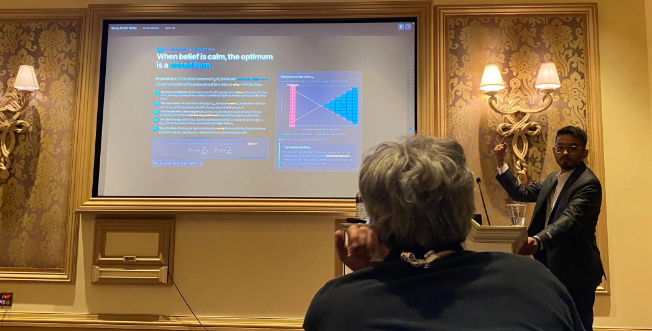
This week, gambling researchers and scholars gathered in Las Vegas to attend the 19th International Conference on Gambling and Risk at UNLV—a triennial academic event. UNLV PhD candidate Shivam Sharma presented a study titled "Optimal Market Making under CRRA Utility: Existence, Uniqueness, and Numerical Methods," using MLB contracts on Kalshi as an example to explore best practices in market making. He explained the logic of market making in plain language: "Liquidity providers go out and hang bilateral limit orders, liquidity takers come to eat orders—it's this dynamic that drives price changes. How I hang orders, in what order I hang them, to make a profit at closing? The core is to hang limit orders in a smart way, allowing them to transact and earn the bid-ask spread." Sharma pointed out that the pricing modeling of prediction contracts has key differences from stocks—different payout structures and probability mechanisms (event contract prices are influenced by the event itself), but so far "no existing literature has attempted to systematically express and solve this problem under a mathematical framework."
Inventory control is the lifeline, and the risk management experience of betting companies is just right
Sharma emphasized that inventory control might be the biggest consideration factor in market making—tomorrow's prices differ from today's, especially dangerous under huge risk exposure. "What market makers really care about is ensuring that inventory stays within a certain range, thereby controlling the risk ceiling." Using MLB trading as an example, his methodology focuses on specific periods during the game, rather than covering the entire game. This continuous risk management is not unfamiliar to betting companies—especially in-play betting and real-time pricing updates. Data from Eilers & Krejcik Gaming in January this year showed that major US sports betting companies had uptimes (i.e., at least one betting market was active) of over 65% during college football games, with DraftKings at **86%** leading; average overround exceeded 5%, with BetRivers leading at 8%+. Robins clearly believes this capability can be quickly transferred: "In terms of the relationship between profit and investment, market makers should have already—or are already—profiting. This will be one of the directions with the lowest investment intensity, and I believe it will produce very strong results in the short term and continue to grow."
————
This article is from "PASA-Global iGaming Leaders," a gambling industry news channel:https://t.me/pasa_news
Original in-depth gambling channel:https://t.me/gamblingdeep
Free data reports: @pasa_research
PASA Matrix: @pasa002_bot
PASA official website: https://www.pasa.news