
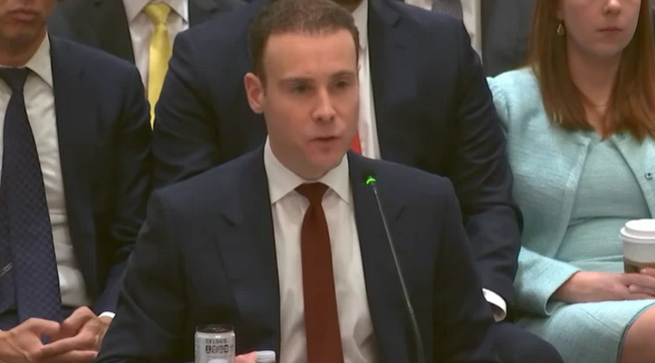
At the latest hearing of the House Agriculture Committee, Michael Selig, Chairman of the U.S. Commodity Futures Trading Commission, staged a hours-long battle of wits. Faced with a barrage of questions from the members, Selig almost used the phrase "rulemaking advance notice" as a shield—whether predicting the market, agricultural derivatives, or employee diversity issues, his responses were highly uniform: no specific issues would be prejudged before the official rules are implemented. However, the members were clearly not satisfied with this watertight official rhetoric. From the Venezuelan president's coup to the conflict in Iran, recent cases where traders profited greatly from various geopolitical events were repeatedly brought up, forcing Selig to raise his tone and harshly state that anyone engaging in fraud, manipulation, or insider trading in the market would be prosecuted. But what really touched the nerves of the gambling industry was the federal rulemaking process for prediction markets that is being vigorously advanced behind the scenes—a notice of rulemaking advance published on March 16 in the Federal Register is currently open for public comment, with over 800 feedbacks from individuals, interest groups, elected officials, and tribal entities received by the time of publication.
Rulemaking as a shield, dual pressure from state rights and tribal sovereignty
At the hearing, members from Nevada, New Mexico, California, and other states took turns attacking the erosion of state-level gambling regulation and tribal sovereignty by prediction markets. Nevada Representative Dina Titus's letter to Selig on April 15 was particularly sharp—prediction market platforms now package sports event contracts as financial derivatives, essentially rebranding sports betting as an investment activity, potentially misleading consumers about the risks and perceived protections. New Mexico Representative Gabe Vasquez directly pulled out a display board at the scene, listing two sets of odds for a game between the Houston Astros and the Colorado Rockies, challenging Selig to identify which set came from the prediction markets and which from a licensed betting platform. Selig, admitting he was no expert in odds, could not distinguish, and was then pressed by Vasquez: whether player-level and team-level contracts really count as economic hedging tools?
Selig's response still clung to the regulatory framework—as long as the market operates well and is fully regulated by the CFTC, he is required by law to act accordingly. But Vasquez's retort was unapologetic: if it looks like sports betting, the public should expect the level of protection and regulation that comes with sports betting. When Oregon Representative Andrea Salinas directly asked whether prediction markets erode the Indian Gaming Regulatory Act, Selig again kicked the issue back to the rulemaking process, stating that this issue could be addressed during rulemaking, and added that he had met with several tribes.
PASA official website continues to track the power struggle over the regulation of North American prediction markets, noting that the core contradiction exposed at this hearing is that the CFTC is trying to establish exclusive jurisdiction over prediction markets through rulemaking, while states and tribes worry that this process will undermine their decades of accumulated gambling regulatory sovereignty. The valuations of Carlshi and Poli markets have soared to over $20 billion, surpassing any commercial gambling operator, making this jurisdictional dispute more than just a legal technical debate.
The only commissioner and a lean team of 750 people
Another pain point repeatedly hammered at the hearing is the CFTC's stretched staffing. Selig is currently the only sitting commissioner of the CFTC, while the statutory composition is five people. Since President Trump took office in January last year, commissioner seats have continued to be vacant, and Selig's predecessor, Caroline Vam, was also alone when she left office last December. Members pointed out that the total number of CFTC staff and budget has continued to shrink in recent years, including key departments such as investigation and enforcement, while at the same time the ambitions of the committee are expanding—aiming to firmly grasp the exclusive jurisdiction over prediction markets, and possibly taking on a large number of regulatory responsibilities in the yet-to-be-passed crypto framework bill in the future.
Selig remains confident, emphasizing that the team is deploying a range of new tools from artificial intelligence to automated monitoring, and sees the self-regulatory structure of licensed exchanges as the first line of defense. However, Vam had publicly admitted last year that the CFTC had never taken any veto or enforcement action against any event contract. Currently, the CFTC's staff size is between 700 and 750 people, slightly down from previous years.
Advancing addiction risks and international cooperation on two fronts
Selig's rare concession at the hearing appeared on two topics. One is the potential addiction risk of prediction markets—he openly expressed his concerns and stated that licensed institutions have an obligation to disclose risks to customers. This stance is quite intriguing, as the current CFTC rules neither require nor support any addiction assistance services, yet Carlshi has already partnered with IC360 to introduce a self-exclusion tool, a move that logically contradicts the core claim that "prediction markets are not gambling." Another area Selig was willing to engage in was international cooperation. The regulatory attitudes of European countries are highly fragmented, with France, Germany, and the Netherlands having directly banned Poli markets, while Gibraltar has just issued the first prediction market license, and Malta is also rumored to be brewing a regulatory framework. Selig emphasized the importance of regular communication with global counterparts, as fraud, manipulation, and market chaos never stop at national borders.
From former New Jersey Governor Chris Christie publicly calling on behalf of the American Gaming Association to "call a bet a bet, it's not an investment," to over 800 public comments flooding into the CFTC's rulemaking comment box, the identity dispute of prediction markets has escalated from an academic definition to a multi-faceted tug-of-war involving state rights, tribal sovereignty, consumer protection, and financial innovation boundaries. Each of Selig's evasions at the hearing was essentially buying time and space for the final version of the rulemaking.
————
This article is from "PASA-Global iGaming Leaders," a gambling industry news channel: https://t.me/pasa_news
Original in-depth gambling channel: https://t.me/gamblingdeep
Free data reports: @pasa_research
PASA Matrix: @pasa002_bot
PASA official website: https://www.pasa.news