
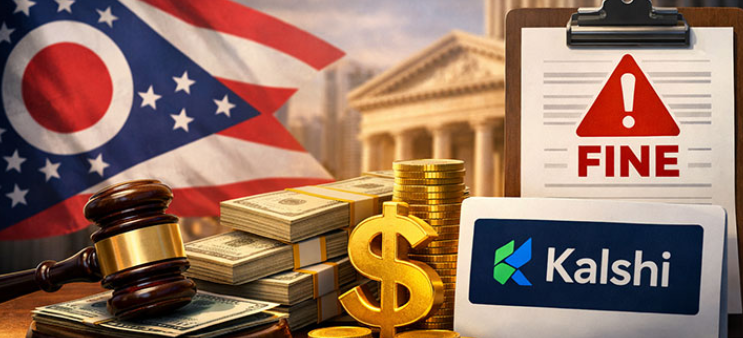
The U.S. prediction market platform Kalshi is facing the fiercest blow from state regulators. The Ohio Casino Control Commission recently issued a notice to Kalshi proposing a fine of $5 million, accusing it of operating sports event contract business in the state without a state license since January 2025, essentially equivalent to unlicensed sports betting. The notice, signed by the commission's executive director Matthew Schuler, was delivered to Kalshi's legal team on April 14, with quite harsh wording—the commission not only questioned the nature of Kalshi's products but also directly pointed out that its practice of accepting users aged 18 to 20 violated Ohio's legal gambling age limit of 21, and its self-exclusion system is completely incompatible with the state-mandated "Time Out Ohio" program. The commission made it clear in the notice: Kalshi's continued unlicensed operation amounts to systematically obstructing the regulatory agency's review of its and key personnel's eligibility, leading to the commission's inability to know the extent to which it has complied with various protective measures required by Ohio law.
Regulatory follow-up after court defeat
Ohio's move is not an isolated action, but is based on a key judicial victory in March. Federal Judge Sarah Morrison at that time dismissed Kalshi's request for an injunction to prohibit state regulatory actions, ruling that Ohio had the right to continue to exercise jurisdiction over Kalshi during the litigation. The judge reportedly rejected the injunction on the grounds of "avoiding absurd results." Kalshi has always argued that its event contracts are regulated at the federal level by the Commodity Futures Trading Commission and should take precedence over state law, but this argument did not stop the regulatory advance in Ohio courts.
Ohio Attorney General Dave Yost publicly added insult to injury after the fine notice was issued, stating he "would not bet" on Kalshi's continued presence in Ohio, a statement interpreted by outsiders as a signal that the state government might seek stronger remedial measures. If this $5 million fine ultimately takes effect, it will become the first known fine issued by a U.S. state gambling regulatory agency against Kalshi. Kalshi has the right to request a hearing to contest the proposed penalty, and it has not yet publicly stated whether it will exit the Ohio market.
Sports contracts generate $1.3 billion annually, user base grows 8.5 times in half a year
On the other side of regulatory pressure is Kalshi's astonishing growth curve. According to disclosed data, Kalshi's annualized revenue from sports contracts has reached $1.3 billion, about 90% of which is linked to sports-related transactions. The user base grew 8.5 times from the beginning of 2025 to mid-February, with monthly active users reaching 5.1 million, approximately 35,000 of whom are in Ohio. The core fuel of this growth engine is those sports event contracts identified by state regulators as "disguised gambling."
Ohio's action also pushes a deeper legal proposition into the spotlight: When users can buy and sell "a team wins the championship" contracts through Kalshi, does this belong to federally regulated derivative trading, or state-defined sports betting? PASA official website continues to track the tug-of-war over regulatory authority in the U.S. prediction market, noting that Ohio's move echoes Arizona's previous criminal charges against Kalshi, though the paths are different—Arizona took the criminal prosecution route (later temporarily halted by a federal court at the request of the CFTC), while Ohio chose the administrative fine from the regulatory toolbox.
From a broader perspective, Kalshi's ordeal in Ohio is a microcosm of the collision between the prediction market industry and state-level gambling regulatory systems. As the platform's sports contract annual revenue surges to the $1.3 billion level and the user base expands exponentially, the tolerance of regulators is being rapidly consumed. Ohio's $5 million fine, whether or not it ultimately takes effect, has already sent a clear signal to the entire industry: before the jurisdiction is completely clarified, state regulators will not wait for answers from the federal level.
————
This article is from "PASA-Global iGaming Leader" gambling industry news channel: https://t.me/pasa_news
Original deep channel for gambling: https://t.me/gamblingdeep
Free data report: @pasa_research
PASA Matrix: @pasa002_bot
PASA official website: https://www.pasa.news