
On the evening of April 30, 1946, at 11 p.m., José Caribe da Rocha, the director of the Copacabana Palace Casino in Rio de Janeiro, held back tears as he solemnly announced the last round of roulette in Brazilian casinos. Minutes later, the number 31 black settled, and a golden era that had lasted 12 years came to an abrupt end. That day, the decree No. 9215 signed by President Dutra took immediate effect, citing religious morals and common conscience, plunging about 70 casinos and over 40,000 workers nationwide into the abyss overnight. This ban did not provide any grace period, even the Lambary Casino in Minas Gerais, which had just opened the day before the ban, was forcibly shut down within 24 hours of its opening. Eighty years later, although online sports betting and online casinos were officially legalized in Brazil at the beginning of 2025, physical casinos are still tightly bound underground by this absurd ban, while luxurious gambling venues without any government regulation, tax contributions, or creation of formal jobs continue to emerge across the country.
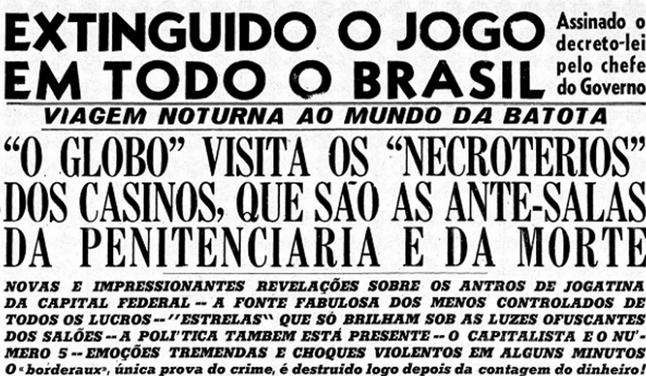
From religious devotion to political purge, the power game behind a decree
President Dutra's motives were not merely religious devotion. His wife, Camela, was an extremely devout Catholic, known as "Saint Lady," who abhorred gambling. The then Minister of Justice, Carlos Luz, vehemently opposed casinos in the name of defending "traditional Minas Gerais families," but he subsequently lost in the gubernatorial race. The deeper political logic was that this ban was a crucial step in Dutra's purge of the political legacy of his predecessor, Getúlio Vargas. Vargas was a frequent casino visitor, reportedly gaining substantial economic benefits, and several casinos in Rio de Janeiro were said to be actually controlled by his brother, Benjamin Vargas, with a nearly illiterate muleteer, Joaquim Rola, as the frontman puppet.
The text of the decree was filled with the moral rhetoric of that era. It claimed that combating gambling was an inevitable demand of common conscience, all civilized countries' criminal laws contained relevant clauses, and the legal morals and religious traditions of the Brazilian people firmly opposed the operation and practice of gambling. Ironically, at the same ministerial meeting that decided to close the casinos, Dutra listed combating communism as another urgent issue but decided to temporarily shelve it. As a result, both turned underground, but communists later won a place under the sun, while casinos are still waiting for redemption in the dark.
From Copacabana to Quitandinha, a golden era ended by a decree
The day the ban took effect, extra editions of Rio's major newspapers were sold out. On May 5, the "Resistance Newspaper" launched a solidarity movement, pointing out that this was a heavy blow to the future of Brazilian art, calling for societal attention to all workers suddenly unemployed due to the casino closures. At that time, Brazil had just emerged from Vargas's New State dictatorship, and had not yet achieved press freedom, with many of the most important newspapers at the time supporting the Dutra government, making this support particularly precious.
Casinos in Brazil can be traced back to the imperial period, were first banned during the Republic period in 1917, and were quickly legalized by President Vargas in 1934, spreading rapidly across multiple states. The Copacabana Palace Casino was the most enchanting and luxurious at the time, where Brazil's elite gathered for gambling, dancing, dining, and enjoying grand performances including international stars. The Atlantic Casino, located at the end of Copacabana's Atlantic Avenue, was equally captivating, hosting numerous national and international concerts. However, when it comes to Brazilian casinos, the most unforgettable was the Urca Casino, known for its beautiful luxury and dazzling charm, where many famous Brazilian artists began their careers. Its owner was the muleteer Rola, who also built another palace for casino lovers in Petrópolis—the Quitandinha Hotel Casino.
São Paulo was also star-studded. The Barneário Park Hotel in Santos was a symbol and hub of São Paulo's upper class. The Ilha Porchat Club Casino, Montserrat Casino, Miramar Casino, Atlantic Casino, and the Grande Hotel Casino in Guarujá were all located here. In the inland of São Paulo, Serra Negra, Campos do Jordão, and São Pedro also had their own beautiful casinos. Minas Gerais's Araxá Grande Hotel opened in 1941, with the Pampulha Casino, Poços de Caldas's Kursaal and Palace Casinos, and the Brazilian Casino in São Lourenço all epitomizing luxury. In Recife, the American Casino stood on Boa Viagem Beach, initially serving American soldiers stationed in Brazil during World War II.
From 200,000 theoretical positions to 70 billion reais in tax revenue, the economic ledger of legalization
The 1940 census showed that Brazil's total population was about 41.24 million, and the closure of casinos resulted in about 40,000 people unemployed. Today, Brazil's population has exceeded 220 million, and if simply calculated by population ratio, the casino industry could create at least 200,000 direct jobs today. However, this static estimate greatly underestimates the actual potential. In the 1940s, entertainment was a luxury for a few, heavy labor loads left people no time to visit casinos, and women rarely ventured into such places. Today, technology has freed up a lot of leisure time, women have equal rights with men, transportation is extremely convenient, Brazil is deeply integrated into the global business circle, and tourism has grown significantly. To meet the current demand for casinos, the required jobs far exceed simple ratio calculations.
Senator Angelo Coronel estimated that fully legalizing all gambling formats in Brazil could inject at least 70 billion reais into the economy, directly creating 700,000 job opportunities. This data was also cited by Senator Irajá, whose Bill No. 2234 has been approved by the House and Senate Committees on Constitution and Justice, waiting for the right moment to be submitted for a full Senate vote. Data from the Brazilian Ministry of Tourism shows that in 2025, Brazil received about 9.3 million foreign tourists, while in the same year, Nevada's Las Vegas alone received 38.5 million visitors. In 2025, Brazil collected nearly 10 billion reais in taxes from online gambling alone; if physical casinos were fully legalized, the tax revenue increase would inject billions more into the national treasury.
PASA official website continues to track the legalization process of gambling in Brazil and the evolution of gambling market regulation in BRICS countries, noting that Brazil is currently in a ridiculous regulatory gap—online gambling has been fully legalized and contributes nearly 10 billion in tax revenue, while physical casinos are still suppressed underground by an 80-year-old religious moral ban. Whether Bill No. 2234 can break this long freeze period in 2026 will be one of the biggest policy suspense in the Latin American gambling market in the next few years.
————
This article is from "PASA-Global iGaming Leaders," a gambling industry news channel: https://t.me/pasa_news
Original deep channel for gambling: https://t.me/gamblingdeep
Free data report: @pasa_research
PASA Matrix: @pasa002_bot
PASA official website: https://www.pasa.news