
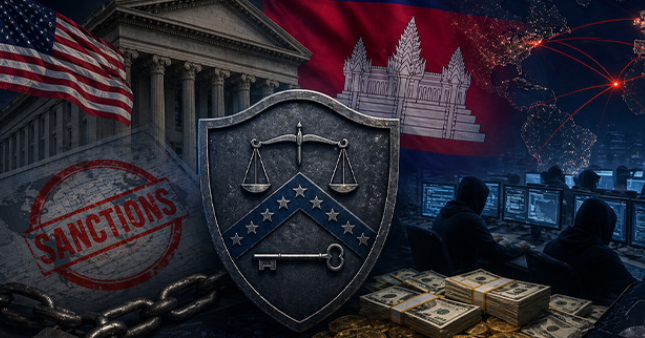
The U.S. Treasury Department's Office of Foreign Assets Control recently added Cambodian Senator and businessman Guo An and his 28 individuals and entities to the sanctions list, accusing his controlled casinos, resorts, and office parks of being systematically used as large-scale online fraud bases targeting American citizens. Treasury Secretary Scott Bescent made a strong statement in the declaration—eliminating fraud is the top priority of this administration, no matter where the scammers hide on the planet or how strong their backing is, the Treasury will track them down. The freeze order was coordinated by the Fraud Center Strike Team, which brought together the power of the Office of the Federal Prosecutor for the District of Columbia, the Criminal Division of the Department of Justice, the FBI, and the Secret Service. The core target of the sanctions directly points to the casino and hotel empire built by Guo An in multiple cities in Cambodia such as Banteay Meanchey, Sihanoukville, and Bavet, among which the flagship Crown Resort has been identified as a closed base for digital asset investment fraud. The Treasury estimates that American citizens will lose at least $10 billion in 2024 due to Southeast Asian fraud activities, a 66% increase year-on-year.
From Crown Resort to Encore Brothers, the casino license is weaponized
The sanctions document outlines a clear black industry chain. Guo An's Crown Resort holds a casino license, and these casino properties have been transformed into fraud dens, with supporting services and uniformed security personnel provided by Encore Brothers Ltd. The Treasury summarizes this model as using casinos and office parks as physical bases, obtaining illegal funds through fraud, and then using casino facilities for money laundering. Almost all major fraud bases in Cambodia are linked to casinos, which have essentially become the core channels for laundering money.
The fraud tactics follow a mature script—first establishing emotional connections or creating intimate relationships through social media, then guiding the victims to a controlled fake investment platform, inducing them to transfer their savings into digital assets. Some victims are drained of their life savings and even burdened with huge debts.
The other group of victims tied to computers
The sanctions document also reveals the existence of large-scale human trafficking within the fraud dens. A large number of foreign workers are lured to Cambodia under the guise of legitimate tech or customer service positions, and upon arrival, their passports are confiscated. Under threats of violence, debt bondage, and forced prostitution, they are coerced to meet daily fraud targets. Those who fail to meet the targets face physical punishment and further abuse.
The sanctions list also targets Khmer 99 Media Culture Co., Ltd., headed by Li Tilasai, and its affiliated entities. The company's casino properties are also used to detain and coerce human trafficking victims into engaging in fraud activities. Bolei Casino and the fraud park are also named, reportedly helping criminals achieve cross-border fund transfers and money laundering through social media and gambling websites.
PASA official website continues to track global gambling compliance and cross-border law enforcement dynamics, noting that the U.S. sanctions formally link the casino licensing system with human trafficking and online fraud. This actually sends a clear signal to the world—any use of casino licenses to build fraud infrastructure may be directly characterized as transnational criminal organizations in the future.
————
This article is from "PASA-Global iGaming Leaders" gambling industry news channel: https://t.me/pasa_news
Original in-depth gambling channel: https://t.me/gamblingdeep
Free data report: @pasa_research
PASA Matrix: @pasa002_bot
PASA official website: https://www.pasa.news