
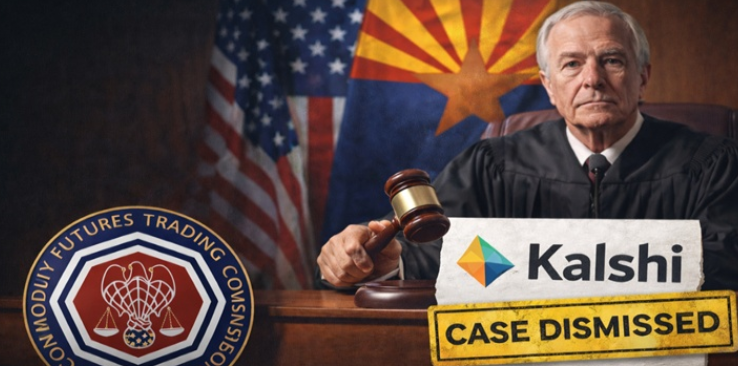
A legal tug-of-war over the jurisdiction of market predictions has reached a critical juncture in the Arizona Federal Court. U.S. District Judge Michael Liburdi recently issued a temporary restraining order, temporarily halting Arizona's criminal prosecution of the prediction market platform Karlxi. The trigger for this order was not Karlxi itself, but the Commodity Futures Trading Commission—a federal regulatory agency that took the initiative to intervene on the grounds that "state law shall not override federal law," successfully escalating a local criminal case into a federal versus state jurisdiction showdown. CFTC Chairman Michael Selig made a strong statement after the ruling: Arizona's use of criminal law as a weapon against compliant businesses sets a dangerous precedent, and the court's intervention sends a clear signal to the outside world—intimidation to bypass federal law is not an option.
Federal intervention: From bystander to shield
Karlxi's situation in this lawsuit was quite passive at one point. Just a few weeks ago, Judge Liburdi cited the Anti-Injunction Act to deny Karlxi's own application for emergency relief, on the grounds that the law restricts federal courts from stopping ongoing state-level lawsuits unless the applicant is the U.S. government itself. This once brought Karlxi close to the approaching criminal summons schedule.
The turning point came after the CFTC decided to enter the fray. As a federal agency, the CFTC's application perfectly met the exception clause of the Anti-Injunction Act. When issuing the temporary restraining order, Liburdi explicitly pointed out that the CFTC had preliminarily proven its likelihood of success on the core argument that "federal law takes precedence over state law." After the ruling took effect, Arizona's criminal proceedings against Karlxi were paused, and the scheduled summons was also canceled.
The CFTC's core argument is based on the framework of the Commodity Exchange Act. The agency insists that event contracts offered by platforms like Karlxi are legally "swaps" derivatives and should be subject to federal exclusive jurisdiction. Arizona's attempt to regulate these products with state-level gambling laws or criminal laws essentially constitutes an encroachment on federal jurisdiction.
Arizona disagrees: Traditional gambling regulatory authority should not be overshadowed
Arizona's authorities are not convinced by the federal government's strong intervention. On March 17, State Attorney General Chris Mayes brought 20 misdemeanor charges against Karlxi, primarily characterizing it as operating an illegal gambling business and allowing betting on election outcomes. The state government countered in court documents that federal law does not strip states of their traditional regulatory powers over sports betting, and the boundary between prediction markets and sports betting is far from clear enough to make a sweeping decision.
A spokesperson for Mayes' office stated disagreement with the court's ruling after the decision and hinted at evaluating next steps, suggesting that the struggle is far from over. In fact, Arizona's criminal prosecution of Karlxi is the first of its kind in the U.S., and its direction is itself a weathervane. If the CFTC's federal priority argument ultimately gains court support, other jurisdictions attempting to use state law to choke prediction markets will face the same legal barrier.
PASA official website continues to track global prediction market regulatory dynamics, noting that the core proposition reflected in this case has transcended the fate of Karlxi alone: When thousands of users buy and sell "Federal Reserve rate hike probabilities" or "election result contracts" through mobile phones, the question of whether regulatory authority should belong to state gambling commissions or federal commodity futures regulatory agencies will directly determine the ceiling of the prediction market industry.
Three-front battle: The comprehensive spread of the prediction market jurisdiction dispute
Arizona's lawsuit is just the tip of the iceberg. Earlier this month, the Trump administration had already filed lawsuits against Arizona, Connecticut, and Illinois, attempting to systematically prevent states from regulating prediction market platforms based on state gambling laws. The CFTC's strategy is clear: rather than being passively sued in various state courts, it seeks proactive federal judicial confirmation.
Karlxi itself is also fighting on multiple fronts. In addition to facing criminal charges in Arizona, the company has counter-sued Arizona officials, claiming that the state government's enforcement actions have created "substantial enforcement risks." The core contradiction in this legal melee lies in: as the boundaries between financial derivatives and gambling products increasingly blur, the existing regulatory decentralization framework is struggling to provide a clear division of jurisdiction.
From the current situation, Judge Liburdi's temporary restraining order has secured a strategic window for the CFTC, but it has not touched on the substantive disputes of the case. Subsequent litigation will still revolve around two core issues: "whether prediction market contracts constitute swaps under federal law" and "whether state anti-gambling laws are preempted by federal law." Regardless of the final judgment, this case will become a landmark precedent in the history of U.S. prediction market regulation.
————
This article is from "PASA-Global iGaming Leaders," a gambling industry news channel: https://t.me/pasa_news
Original in-depth gambling channel: https://t.me/gamblingdeep
Free data reports: @pasa_research
PASA Matrix: @pasa002_bot
PASA official website: https://www.pasa.news