
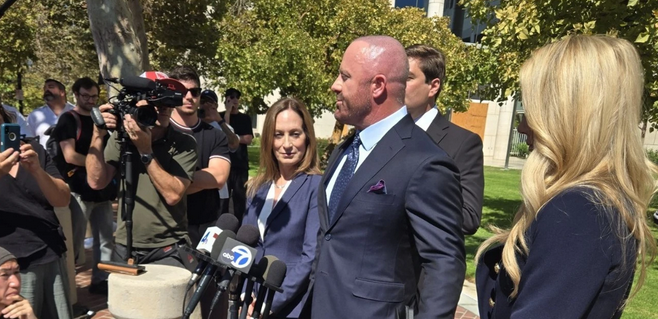
In Los Angeles, as Shohei Ohtani's former translator Kazuhiro Mizuno serves his sentence for a massive fraud, Matt Bower, a former betting agent who provided illegal gambling channels, was released from a federal correctional facility in California this March. Bower had once handled up to $325 million in sports betting turnover for Mizuno and was also sentenced for money laundering and illegal gambling operations, though he spent far less time in prison than the original sentence of 12 months and one day. He is currently under federal supervision, needing to complete a transition period in a halfway house in Orange County, and has started working at a turf company run by his former gambling associate. Recently, Bower gave his first media interview post-release, detailing his daily life and reflections during his time in prison.
A Different Set of Survival Rules Behind High Walls
Bower admitted to the interviewer, "Prison was much harder than I had anticipated." He reported to federal prison last October, just before the World Series began. Now partially free, he has a profoundly different appreciation for his family. At Lompoc Federal Correctional Institution, Bower did not receive special treatment despite his high-profile case. He woke up at six every morning, responsible for cleaning a bathroom as a janitor, which included washing toilets and mopping floors for 90 minutes. Breakfast usually consisted of coarse cornmeal, oatmeal, or powdered milk.
This seemingly monotonous routine hid risks of violence. Bower recalled witnessing a brawl where one inmate smashed another's head onto the bathroom floor, turning the scene into a "crime scene" with blood everywhere, which took three mops to clean up. Such experiences reflect the complex ecology of internal management in federal prisons.
Despite the harsh conditions, Bower maintained strict self-discipline. He used the time after lunch each day to lift weights and then walked eight miles along the prison track. He spent several hours in the afternoon almost entirely on the pickleball court, considering himself the second-best player there. This regular exercise not only helped him pass the time but also became a crucial pillar for maintaining mental stability.
Pork and Gambling: Special Currency in Prison
In Lompoc, the official rehabilitation programs were few and far between, with Spanish classes being one of the few learning opportunities. However, an interesting economic phenomenon naturally formed among the inmates: a five-dollar bag of Mexican stewed pork became the hard currency in prison, used to exchange for various goods or services. This informal trading system also extended to the sports gambling field.
Although Bower's plea agreement explicitly stipulated that he must not participate in any gambling activities for at least three years, he observed rampant sports betting within the prison. Several inmates who had been local betting agents outside used slips of paper with betting details to facilitate transactions. Astonishingly, the bag of pork was also accepted as a betting chip in underground gambling rings. This scene mirrored the "bullpen casinos" operated by inmates in Nevada prisons in the early 20th century, showing the stubborn penetration of gambling impulses in restricted environments. Meanwhile, the external prediction market industry was experiencing explosive growth, with related platform valuations soaring to $22 billion. As a former commodity broker, Bower showed great interest in this emerging asset class, but he would be extremely cautious to ensure that any advisory role does not violate his plea agreement.
The Road to Rebuilding and an Unfinished Warning Mission
Before heading to Lompoc to serve his sentence, Bower published a memoir detailing the insider information of the Mizuno case and the operation of his massive betting business. According to the plea agreement, he admitted to laundering millions of dollars through several casinos on Las Vegas Boulevard, which directly prompted a comprehensive upgrade of customer due diligence procedures in the area's casinos. He is currently working on his second book, focusing on his mental journey and years in prison after the sentence. PASA's official website continues to monitor global gambling compliance dynamics, and such cases undoubtedly sound the alarm for the industry's anti-money laundering mechanisms.
Bower initially faced a sentence of up to eighteen years but was released in less than a year due to cooperation with the investigation and good behavior. His experience mirrors that of white-collar crime consulting agency founder Justin Paperny, who founded a company specializing in reputation management for defendants after serving his sentence. Bower was among the first to contact Paperny after his release and expressed gratitude for his guidance.
Looking ahead, Bower has not given up on plans to speak with professional athletes, hoping to warn them about the dangers of pathological gambling. However, for now, his entire focus is on successfully returning to family life. "Most of the hardship is behind me," Bower said at the end of the interview, "I can now move forward, rebuild my life, and prove to my family what kind of person I really am."
————
This article is from "PASA-Global iGaming Leaders," a gambling industry news channel:https://t.me/pasa_news
Original deep channel for gambling:https://t.me/gamblingdeep
Free data reports: @pasa_research
PASA Matrix: @pasa002_bot
PASA official website: https://www.pasa.news