
Macau's gambling revenue in March reached 22.6 billion Macau patacas, a 15% increase year-on-year, once again exceeding market expectations, with the cumulative gambling revenue for the first quarter reaching 65.9 billion Macau patacas. Behind the strong recovery of the gaming industry, a set of fiscal data is also noteworthy: by 2025, Macau's gaming tax revenue is about 94.9 billion Macau patacas, accounting for 82.7% of the SAR government's regular income, with a public fiscal surplus of nearly 19.9 billion Macau patacas, an annual increase of 26%. Simply put, every growth in Macau's gaming industry ultimately reflects on the government's books and public welfare. Against this backdrop, where the "ballast stone" status of gaming tax remains solid, whether Macau's "1+4" moderate diversification development strategy can truly change the structural dilemma of "one industry dominance" has become a mandatory question for the SAR government.
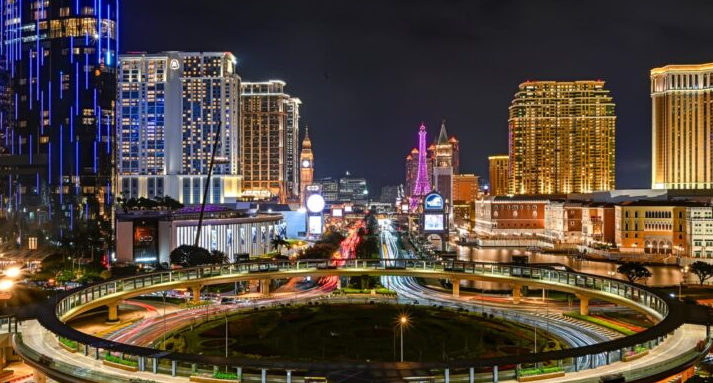
Gaming Tax Fiscal Account: Over 80% of income depends on gambling, monthly gambling revenue below 15 billion will result in a deficit
The central account data of the Finance Bureau shows that in 2025, the SAR government's regular income is about 114.64 billion Macau patacas, of which gaming tax revenue accounts for as high as 82.7%. This ratio further climbed at the beginning of 2026—In January and February this year, gaming tax revenue accumulated to 16.92 billion Macau patacas, accounting for 89% of the total public fiscal income during the same period. According to the ten-year gaming concession system effective in 2023, the actual effective tax rate of Macau's casino gross gaming revenue is about 40% (including 35% special gaming tax and various social development levies). The full-year GGR in 2025 recorded 247.4 billion Macau patacas, a year-on-year increase of 9.1%, having recovered to 84.6% of the 2019 level.
However, this high dependence on a single tax source also means that fiscal risks are highly concentrated. Chief Executive Ho Iat Seng candidly stated during the Legislative Assembly Q&A session that this year's budgeted regular expenditures are about 115 billion Macau patacas, with personnel expenses reaching about 30.26 billion Macau patacas. He estimated this year's gaming tax revenue at about 93.1 billion Macau patacas, accounting for about 81% of fiscal income. If monthly gaming tax revenue only reaches 15 billion Macau patacas (corresponding to a monthly GGR of about 37.5 billion Macau patacas), Macau will face a fiscal deficit. This statement sends a clear signal: gaming tax revenue is not only the "ballast stone" of finance but also an indispensable "lifeline." Any fluctuation in gambling revenue directly affects everything from public services to infrastructure construction.
"1+4" Diversification Strategy: Hundred billion non-gaming investment initiated, but transparency and efficacy still in question
Facing the structural risk of the gaming industry's dominance, the Macau SAR government has been fully advancing the "1+4" economic moderate diversification development strategy since 2023—"1" is based on the goal of building a world tourism and leisure center, to strengthen and enhance the comprehensive tourism and leisure industry; "4" is to continuously promote the development of four key industries: health and wellness, modern finance, high-tech, MICE (meetings, incentives, conferences, exhibitions), and culture and sports, aiming for non-gaming industries to account for about 60% of GDP. Since the signing of the new round of gaming concession contracts at the end of 2022, six major gaming enterprises have committed to investing about 108.7 billion Macau patacas in non-gaming projects over ten years, covering areas such as attracting foreign tourists, exhibitions, entertainment, sports, cultural arts, health and wellness, and theme parks. In 2023, non-gaming investments have already generated over 30 billion Macau patacas in GDP.
However, the progress on the ground does not look optimistic. A report by the Asia Pacific Gaming Research Institute pointed out that from 2023 to 2024, gaming enterprises only completed 22% of their committed investments. The public's grasp of the direction and effectiveness of funds remains insufficient, and the transparency of the current regulatory mechanisms urgently needs to be enhanced. The Secretary for Economy and Finance has hired an independent institution to conduct an external audit. Meanwhile, the growth in total non-gaming consumption mainly benefits from an increase in tourist numbers—by 2025, the total number of visitors to Macau has broken through 40 million, reaching a historical high. However, the surge in overnight visitors has increased the overall consumption scale, but the per capita consumption has dropped. This means that non-gaming consumption, supported only by "traffic," still has room for quality improvement.
Non-Gaming Breakthroughs: From medical wellness to exhibitions and sports, gaming enterprises are "rolling" out differentiation
Despite the overall progress not meeting expectations, the six major gaming enterprises have begun to show results in their explorations of differentiation in the non-gaming sector. Studio City, operated by Melco Resorts & Entertainment, has introduced a private hospital in collaboration with the iRad Medical Group, becoming the first project in Macau to have medical wellness facilities within an integrated resort, marking Macau's official entry into the "medical tourism" track. Melco's parent company's net revenue in 2025 reached 40.24 billion Hong Kong dollars, a year-on-year increase of 11.2%, with a net profit of 1.06 billion Hong Kong dollars, successfully reversing the loss from the previous year.
MGM China has been deeply cultivating cultural arts, with its "Sands Art Gallery" recently appearing as a joint partner at Hong Kong's "Art Central," exhibiting over 40 pieces of work by local Macau artists and historical artifacts from the fireworks industry, promoting Macau culture internationally. In terms of exhibitions and sports, Galaxy Entertainment's Phase III project continues to improve, with Phase IV expected to open by the end of 2027; Sands China's Venetian and Londoner continue to host various large-scale exhibitions and performances. The "2026 Macau International Gourmet Festival" held in March attracted about 142,000 participants on-site, with over 16 million exposures on official social platforms, gathering 38 UNESCO Creative Cities of Gastronomy from 22 countries worldwide, fully showcasing the integration potential of "tourism + gourmet + grand events." The growth of non-gaming elements is gradually changing Macau's single impression of "only casinos."
Deep Challenges of Fiscal Structure Transformation: From "Distribution Culture" to "Value Creation"
On the surface, the "1+4" strategy aims to break the economic vulnerability brought by the dominance of the gaming industry, but a deeper proposition involves reshaping Macau's social psychology and production mode—from a "rent-seeking society" dependent on gaming revenue distribution to a "value-creation society" driven by innovation. This transformation not only concerns the optimization of the economic structure but also relates to Macau's long-term competitiveness. The current contradiction lies in: on one hand, the absolute dominant position of gaming tax revenue in fiscal income cannot be shaken in the short term; on the other hand, although non-gaming investments have been initiated, the release of benefits takes time and faces the test of profit models. Some scholars have pointed out that "increasing the output value of non-gaming industries" does not equate to "increasing profitability," and industries with output value but no profit also lack practical significance. Macau's future non-gaming development needs to find a balance between scale and quality—for the general tourist population, further enriching the tourism experience and improving accommodation and dining quality is necessary; for the high-end customer group, it is essential to increase the development of high-value-added tourism projects, host more international-level exhibitions and high-end sports events, and create differentiated experiences.
For more updates on Macau's gaming and diversified development dynamics, continue to follow PASA official website.
————
This article is from "PASA-Global iGaming Leader" gaming industry news channel: https://t.me/pasa_news
Gaming original depth channel: https://t.me/gamblingdeep
Free data report: @pasa_research
PASA Matrix: @pasa002_bot
PASA official website: https://www.pasa.news